Range Repair
A Gas Smell in a Beverly Grove Kitchen: Oil-Field Methane, and What the Methane Zone Requires
A gas smell in a Beverly Grove kitchen is a source question before it is a repair question: leave, call the utility, and only then ask whether the ignition system is at fault. This district sits inside LA's mapped Methane Zone.
Written by Noor Haddad Cooking-appliance technician — induction and electric · 8 years in the trade
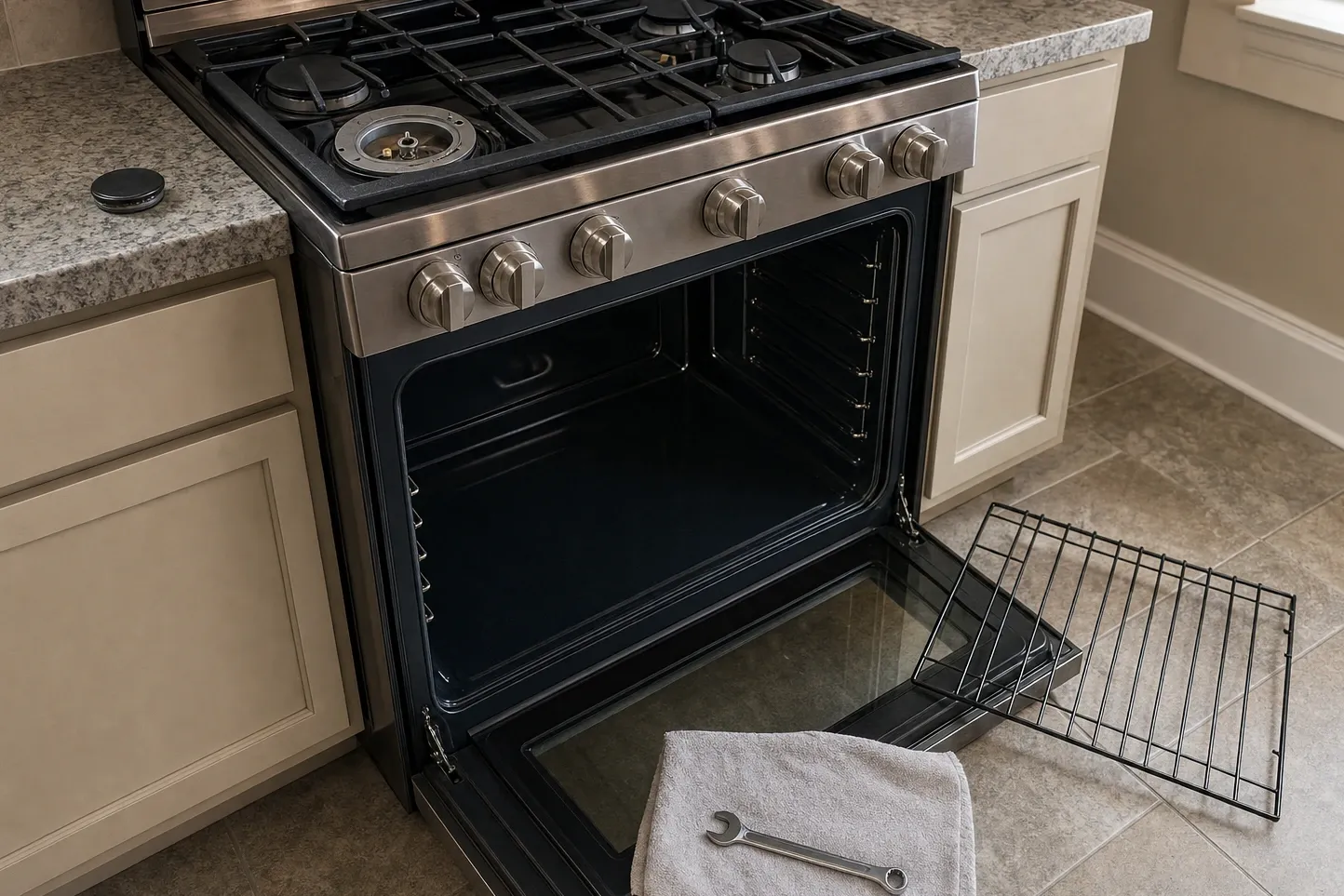
The question worth asking first
If you can smell gas in a Beverly Grove kitchen, the first question is not which Wolf component has failed. It is where the gas is coming from. Beverly Grove and the Fairfax district sit above the Salt Lake Oil Field inside the City of Los Angeles Methane Zone, so “the range must be leaking” is an assumption rather than a finding.
Treat it as a safety call before it is a service call. Get everyone out, leave a door open behind you, do not work switches, do not try lighting a burner to see whether it still behaves, and phone the gas utility from outside the building. Responding to a gas-odour report is exactly what that number exists for. A technician’s work begins afterwards, once somebody has established whether the source is the appliance, the house piping, or the ground beneath the slab.
One version of this smell genuinely is the appliance, and it is worth naming because it is the most common form of the call. A brief whiff for a few seconds before the oven finally catches, every time, and never otherwise, is delayed ignition. That is an ignition fault and it is repairable. A smell present with every knob off is not a Wolf diagnosis at all.
What shortens an appliance life here specifically
What shortens a professional range’s life in this part of Los Angeles is less the soil itself than the way the soil governs work around the appliance. Inside the Methane Zone, Division 71 of the LA Building Code (Ordinance 175790) requires soil-gas testing and a mitigation system graded across Site Design Levels I to V, and it reaches existing buildings via LAMC 91.7104.1 and 91.7104.2 for alterations and changes of use.
In practice a remodel deep enough to pull a permit can acquire a second project: testing supervised by a licensed engineer or geologist, then either a passive barrier-and-vent arrangement or active depressurisation with sensors and alarms, depending on the Site Design Level, with the detection and ventilation equipment approved and enforced by the Fire Department. None of that concerns your cooking equipment. All of it changes when your cooking equipment can be set in place.
The knock-on effect is indirect but real. Ranges get installed ahead of finished millwork to protect a schedule, gas runs get extended rather than properly re-run, and hoods get tied to whatever duct path survived the rest of the job. Beverly Grove’s tight-lot Spanish duplexes and low-rise condos already force ducting into shared shafts, and a permit clock does not improve those decisions. It is a different pressure from Windsor Square, where the constraint is original iron gas piping under a period kitchen, or Toluca Lake and Tarzana, where a pro range has been fitted into a footprint drawn decades before anyone specified one.
Reading the machine you already own
Read the machine before you read the neighbourhood, because these faults have a recognisable shape. A burner that lights from a match but not from its own spark is an ignition problem. Every burner lighting while the oven stays cold points at the oven’s own gas or safety circuit. A knob turning freely that no longer shuts its burner off is mechanical, inside the valve.
The order a technician works it is the order that costs least. Spark at each electrode and a clean ground come first, because weak spark explains more of these calls than anything further down the list. Then port condition and cap seating. Then gas pressure at the manifold with the oven calling, which is where a marginal supply reveals itself instead of being blamed on a valve. Then the safety and flame-sense circuit, then the oven igniter, and last of all the electronics behind the fascia.
That final step carries a local caveat. If the house has methane detection and mechanical ventilation installed under Fire Department approval, none of it should be isolated to make a service visit simpler. It stays live and we work around it.
Repair, or start again
Repair usually wins on a Wolf range, and in this zone the arithmetic tilts further that way, because keeping the appliance where it stands keeps the job outside the permit system while replacing it may not. A component repair is a service visit. Changing the footprint, moving the gas run or re-cutting ducting is construction, and construction here is what invites Division 71 into the kitchen.
The bands are tight enough to decide with. Igniter or spark module work is $180 to $470. Burner valve or orifice service is $270 to $560. Oven thermostat or sensor calibration is $210 to $460. Convection fan or motor work is $260 to $610. Door hinge, glass or seal work is $290 to $650. The one reaching highest is a control board or touch panel at $420 to $950 — and it is also the one most often ordered before the cheaper causes have been ruled out, which is the whole argument for testing in sequence.
What a diagnosis gives you
A diagnosis gives you three things: a named part, the band it sits in, and a clear line between what belongs to the appliance and what belongs to the building. That second half matters more in this service area than in most, and we would rather say plainly that a problem is not ours to solve than sell you a part for it.
On the visit we confirm the reported fault rather than the reported cause, record the model and serial, test in the order set out above, and fit factory-approved parts. If the ignition system needs work, you have the band before anything is ordered. If the answer is that the smell in the room is not coming from the range, you get told that too, along with who should be looking at it instead.
Our diagnostic fee is $89. Call (310) 928-9768, or use the booking link on this page to arrange a visit.
Follow-ups
- I smell gas in my Beverly Grove kitchen. Should I call an appliance technician first?
- No. Leave the house with everyone in it, avoid operating switches, and phone the gas utility from outside so the source can be identified by the people equipped to do it. This district lies over the Salt Lake Oil Field inside the City of Los Angeles Methane Zone, so the range is not automatically the culprit. Once the gas situation is resolved, an appliance fault such as delayed ignition can be diagnosed properly.
- Does the LA Methane Zone affect a straightforward Wolf range repair?
- A repair, no. Division 71 of the LA Building Code, with LAMC 91.7104.1 and 91.7104.2, bites on alterations and changes of use rather than on replacing an igniter, a valve or a sensor. It is the remodel around the appliance — a new footprint, a relocated gas run, re-cut ducting — that can trigger soil-gas testing and a graded mitigation system with Fire Department sign-off on the equipment.
- Why does my oven smell of gas for a few seconds before it lights?
- That is delayed ignition. Gas reaches the burner before the ignition source does its job, a small amount collects, and it lights late with a soft thump. Usual causes are a degraded igniter, blocked ports, a dirty flame-sense circuit or marginal supply pressure. It is worth attending to promptly rather than living with. Igniter or spark module work is $180 to $470, and burner valve or orifice service is $270 to $560.