Range Repair
Wolf range: every burner lights, the oven never does
Why a gas Wolf range can spark six burners perfectly and still refuse to bake, what a tired glow-bar igniter looks and smells like, and the point at which delayed ignition stops being a nuisance and becomes a reason to stop using the oven.
Written by Noor Haddad Cooking-appliance technician — induction and electric · 8 years in the trade
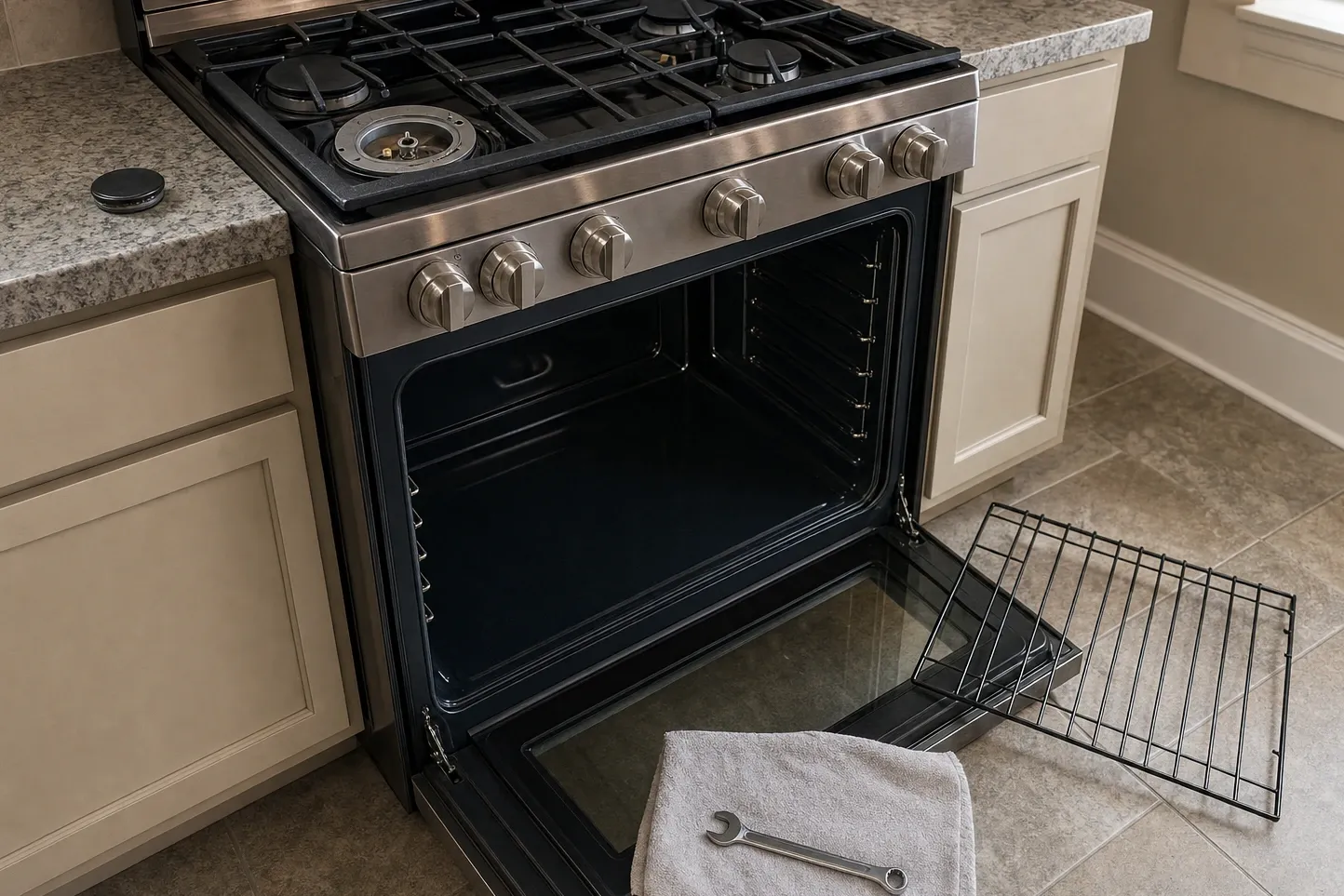
There is one call we take more than any other in Los Angeles kitchens: every burner on the cooktop lights on the first click, and the oven does nothing at all. Or worse, it does something — you set bake, wait, smell gas for a good while, and eventually the whole thing catches with a noise you can feel through the floor.
Both of those are the same part in two stages of failure, and neither of them means the range is finished.
Why the cooktop tells you nothing about the oven
On a gas range the two halves of the machine light in completely different ways. The sealed burners on top are fired by a spark module — a small mains-voltage box that throws a spark at an electrode every time a valve switch closes. That is the clicking you hear.
The oven burner does not spark at all. It uses a hot-surface igniter, a flat ceramic bar that glows orange, and that bar sits electrically in series with the oven’s safety valve. Current flows through the bar, and it is the amount of current flowing that pulls the valve open. Not the heat. Not the glow. The current.
Which is why a perfect cooktop and a dead oven is not a contradiction: they share a gas supply and nothing else that matters.
How a glow bar fails, and why it takes weeks
Hot-surface igniters almost never fail suddenly. They age by rising in resistance, which means they draw less current as they get older, which means the valve gets less of what it is waiting for.
Most igniters in this class need to pull somewhere in the region of three to three and a half amps to open the valve reliably. A bar that has drifted down below that will still glow a convincing orange — bright enough that people tell us on the phone the igniter is obviously fine — and still never open the gas. In between those two states you get the slow decline everybody describes the same way:
- three or four seconds to light when the range was new
- fifteen, then thirty, over a year or two
- a minute, then three or four, and gas you can smell while you wait
- nothing
That middle stage is the dangerous one. The valve is opening late, so gas is pooling in the cavity before there is a flame to burn it. When it finally catches, it lights all of it at once.
What you can check in five minutes
Before you ring anybody, work through this. It takes nothing apart.
- Check the mode. Broil-only, delay start, a sabbath setting or a timer left set will all keep the bake burner off with no fault at all.
- Check for a power blip. If the clock reset or the panel is showing a lock, the oven may simply be waiting for you to clear it. Los Angeles summer brownouts do this more than people expect.
- Confirm gas is reaching the range. The wall valve behind it can get knocked when something is pushed in beside the range. Do the surface burners still light, and do other gas appliances in the house work?
- Count the seconds. Set bake, start counting, and write the number down. Whether it is eight seconds or four minutes is the single most useful thing you can tell us, and it decides which parts come out on the van.
- Look behind the range if you can do it safely. Up on the Tarzana hillsides we find chewed ignition harness often enough that it is worth a torch and a glance.
When to stop and pick up the phone
Some of this is a nuisance you can live with for a week. Some of it is not.
Stop using the oven and call if you can smell gas for more than a few seconds before it lights, if flames roll out of the burner tube instead of staying inside it, if the burner lights with a bang, or if the oven keeps tripping its own cutout. Delayed ignition is not a wait-and-see fault. It is unburned gas accumulating in a closed cavity, and it gets worse in exactly the direction you would not want.
The same goes for a range that has been apart before and now smells of gas at the back. A connection that was disturbed once can be disturbed again.
What the visit actually involves
We meter the igniter’s current draw rather than looking at its colour, then confirm whether the valve responds to a correct current. If the bar is good and the valve is not, that changes the part. We check manifold pressure, because a regulator that was throttled down after a meter swap produces symptoms that mimic an ignition fault, and we look over the burner tube and orifice while everything is open.
Rodent damage to the ignition harness gets rebuilt rather than patched, and the gap that let them in gets blocked, because otherwise we are both back here in November.
Afterwards the flame gets set properly and the oven is run up to temperature against our own probe, with the readings shown to you. The $89 service call covers all of that diagnosis, and it is knocked off the total the moment you give the go-ahead.
Follow-ups
- Can I fit a glow-bar igniter myself?
- Mechanically it is two screws and a plug. Electrically it is a mains-voltage component wired in series with a gas valve, and the range usually has to come out to reach it. If you are not comfortable with both halves of that sentence, leave it — a bar fitted with a pinched lead or a loose ceramic is worse than the one you took out.
- Bake works but broil does nothing. Is that the same fault?
- Usually not. On an all-gas range the broil burner has its own igniter and safety valve, so it fails independently. On a dual-fuel range the broil element is electric and the fault is far more often a relay on the control board than the element itself.
- How long should a glow bar last?
- Years, and it rarely dies cleanly. It ages upward in resistance, so ignition creeps from a few seconds to half a minute to several minutes over weeks. That slow drift is the tell — if lighting is getting slower, the part is already on the way out even while it still works.